0 Comments
Dearest Reader:
Due to various commitments I had along with some travel (including a mini-vacation to North Carolina's Outer Banks), I fell behind with my posts. I just now completed my comments & rating for Kabalevsky's Violin Concerto in C Major -- which was my selection to critique for the week of 7/30. Sooo -- currently I am caught up; however, I'm about to depart again for an unexpected trip to Vermont and upstate New York. Therefore, I'll post a new selection to listen to on Sunday, September 3rd, and then I'll see if I can stay on track for the remainder of the year (minus some additional travel time in October). Thanks for understanding and hanging in there! ; )
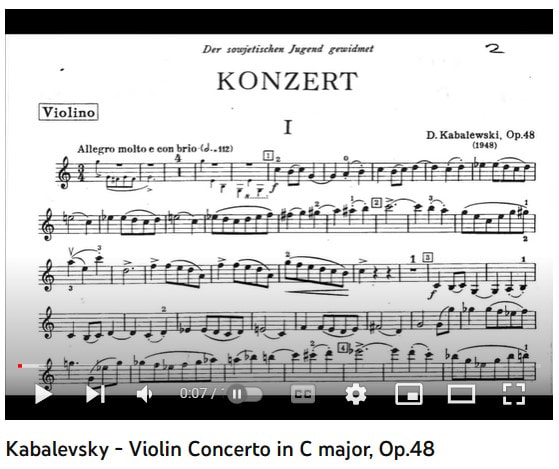
Arrgh – I haven’t been as diligent lately in posting my comments and ratings for my selected pieces, and once again, more time has passed than I should have allowed – including a mini-vacay to the Outer Banks of North Carolina – so I apologize, dearest Reader, for the lateness of this entry (we're now into the week of 8/13)Let me get caught up with a few comments on Kabalevsky’s Violin Concerto; however, I am then going to take another brief hiatus as my wife and I wind up the summer at Big Moose Lake in upstate New York (in the Adirondacks), and I’ll return to post and listen to additional pieces as of the week of September 3rd. Sooo – on to the Kabalevsky. I don’t know much about Kabalevsky the man/composer, but I am familiar with some of his works – particularly the spirited overture to his opera Colas Breugnon (1936, after the novel by Romain Rolland; rev. 1953, 1969) and for his suite The Comedians (1940). Those works are so energetic, I thought I’d give his violin concerto a listen to see if it would match those pieces’ bright and animated character – and to a degree it did. At AllMusic.com, I found this information regarding the concerto: “The Violin Concerto is the first of three instrumental concertos composed by Kabalevsky during the late 1940s and early 1950s and dedicated to the Soviet youth (the others are the Cello Concerto No. 1 and the Piano Concerto No. 3), and was first performed in fall of 1948 by 18-year-old violinist Igor Bezrodny -- not exactly a child, certainly, but the piece is not exactly a simple one either. It seems that Kabalevsky had in mind that each of these three concertos would serve as a model of an advanced study piece for young players….” And this: “Kabalevsky's Violin Concerto is in three relatively brief movements. Snappy rhythms, a main theme with a persistent hemiola, and a cantando second theme in G minor make for a compact, cadenza-less sonata-allegro form first movement (Allegro molto e con brio). The Andante cantabile middle movement is in three clear sections; when the ‘A’ music, with its steadily plodding accompaniment and interesting harmonic twists, returns at the end, the soloist abandons the theme to the orchestra and takes up a flowing obbligato instead. Room is found in the rambunctious Vivace giocoso last movement for a short, transparent cadenza.” The three movements are designated as follows: I. Allegro molto e con brio II. Andante cantabile III. Vivace giocoso The piece is entertaining, energetic, and exuberant – but certainly not to the same level as his more famous pieces I mentioned above. Still, the work is worth a listen! 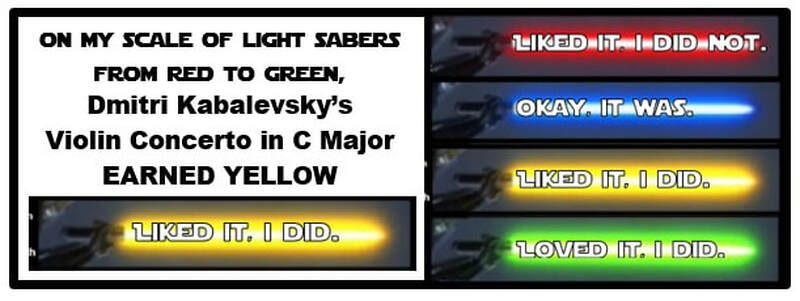
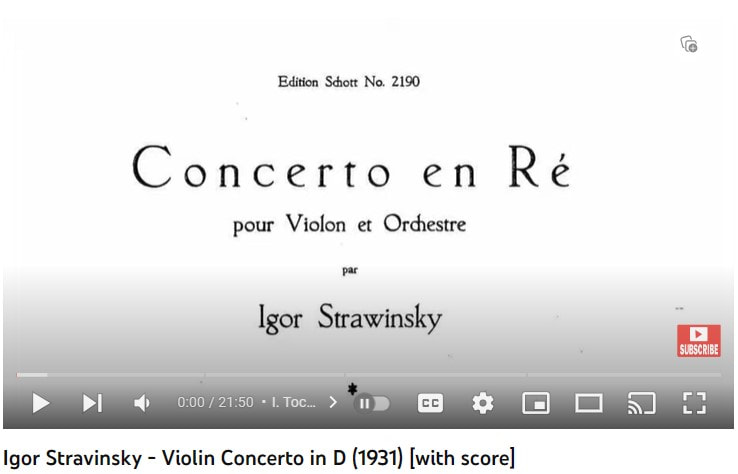
There are pieces by Stravinsky that I enjoy. As a matter of fact, I’m sure you could probably guess which one – you know, his “greatest hits.” However, he’s not a composer I listen to very often and/or one I know very much about. Therefore, I thought I’d try listening to something by him this week, and I chose the violin concerto in D major at random. The concerto, which premiered in 1931, is a neo-classical piece and it’s comprised of four movements:
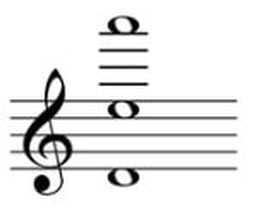
FYI: Stravinsky's chord resolves easily to an A major chord (think of an A major chord where the third goes up a half-step) or a D major chord (think D major where the third comes down a full step). However, in the case of this concerto, the chord is played in stark severity at the start of each movement followed by three pounding quarter notes or -- in the third and fourth movements -- some variation of eighth and/or sixteenth notes; then the movement moves on, as if a speaker were to pound a gavel at the start of a meeting to signal the start of the anticipated discussion. The first movement is jaunty and whimsical. I did like the “banter” between the violin and the low sixteenth notes at section 22 (is that a bassoon?), the various tricky rhythms throughout the piece, and the quirky dissonance which added a flavor of imbalance. Some sections of the work (the movement and the entire concerto) reminded me of the comic energy and industrial tone of Raymond Scott’s “Power House." Movements II and III, as noted above, are designated as “Arias,” so they have they have the feel of musical “fantasies” rather than conventional forms for a concerto. As a result, the piece seems a bit disjointed, lacking the coherence of the traditional form. According to the article in Wikipedia, “Though Stravinsky told his publisher he wanted to write ‘a true virtuoso concerto,’ ‘the texture is always more characteristic of chamber music than orchestral music’ – and that is true, as throughout much of the concerto, the violin and orchestra seen to play off each other rather than it being a piece to showcase the violin. The final movement is a fun piece that combines all of the quirky flavors of the first three movements but moves at a faster clip – and then at section 119 it picks up the tempo even more! Interestingly, the concerto was choreographed twice by George Balanchine. First, as "Balustrade" in 1941. Then, in 1972 he created a new ballet entitled "Violin Concerto," and he later renamed it the “Stravinsky Violin Concerto.” That ballet premiered in 1972 with the New York City Ballet. I can see where the dissonance and idiosyncratic rhythms would have appealed to Balanchine. It’s a fun piece. Maybe not a concerto I’ll listen to often, but it was certainly enjoyable – and I think it would be fun to see the choreography set to the piece. 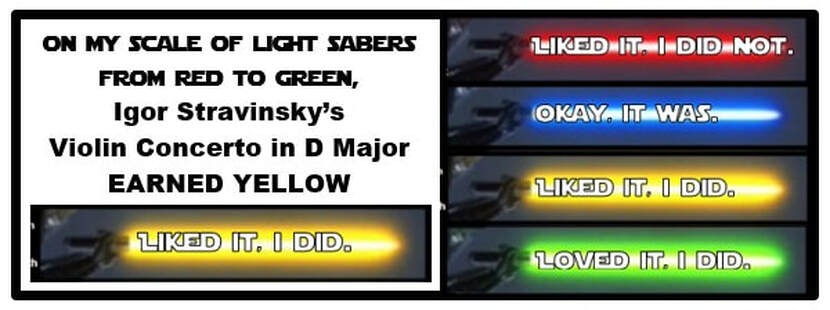
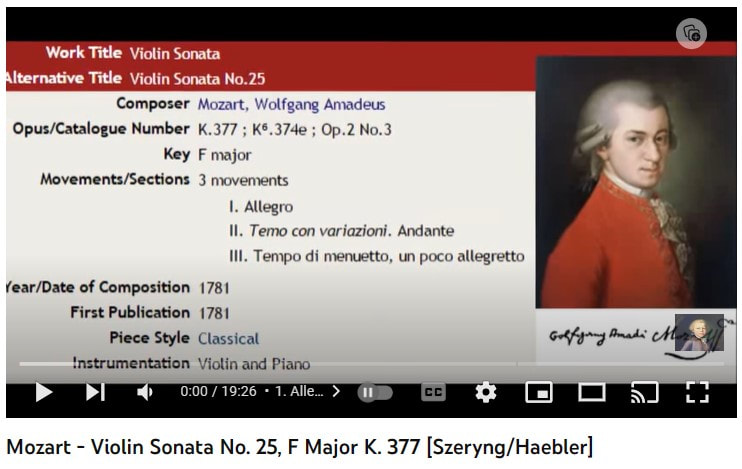
About a week and a half ago I jumped into my car to run an errand, the radio popped on, and the announcer revealed that I had just missed a violin sonata by Mozart. A violin sonata? I’m aware of Mozart’s piano sonatas – the second movement from one of them even made it onto my list of Top 100 Classical Music Favorites (HERE) – but violin sonatas? I hadn’t heard of these pieces – OR – if I have heard them on the radio, I s’pose that I just wasn’t paying attention. Long story short: I decided to listen to one of Mozart’s violin sonatas as my featured piece for the week (turns out he wrote 36 of them – info HERE), and I picked number 25 in F major at random. And no surprise – I got what I expected: a delightful piece of violin music – accompanied by the piano – written in three movements:
However, in relation to that “accompanied by the piano” comment, check this out from a blog piece by the LA Philharmonic: “In addition to everything else – composer of astonishing invention and fluency, virtuoso pianist, all-round boy wonder – Mozart was an accomplished violinist and violist. He could hardly have avoided it, as his father Leopold was a master violinist and the author of the leading violin manual of the day. So it is hardly surprising that Mozart composed a number of sonatas for violin and piano – or rather, for piano with violin. In the duo sonatas that Mozart composed throughout his career, there is a constant development of equality in the partnership, which initially placed the burden entirely on the keyboard and left the string part almost optional.” Of course – LOL – I was, in fact, surprised that there were so many of these pieces – new classical music territory for me – but the unnamed bloggist hit the piano/violin relationship nail on the head. Here’s how the sonata is described in the article (HERE): “The first movement is driven by the energy of fleet triplets flowing between the instruments as they trade melody and accompaniment. The second movement is an extraordinary set of variations in D minor. The Minuet finale, complete with a contrasting Trio section in B-flat, reduces the violin to its most subservient role.” Still, the piece is enjoyable – though it includes nothing as catchy or as memorable as Mozart’s “Eine Kleine Nachtmusik,” his Ronda Alla Turca, his overture to The Marriage of Figaro, the “Elvira Madigan” theme found in his Piano Concerto No. 21, and so on. Still, the piece is pleasant, breezy, and likable enough that I plan to investigate more of these works by Mozart. Coincidentally – in a Baader-Meinhof moment the other night – I woke up in the middle of the night and couldn’t fall back to sleep. I put in my earbuds and listened to a bit of classical music to see if that might help. I clicked on my I-Heart-Radio app and listened to KUSC out of Los Angeles, and I caught the tail-end of a pleasant, breezy and likeable enough piece. The announcer then came on and told me that it was Mozart’s violin sonata number 36. A sure sign that I need to listen to more of these works! 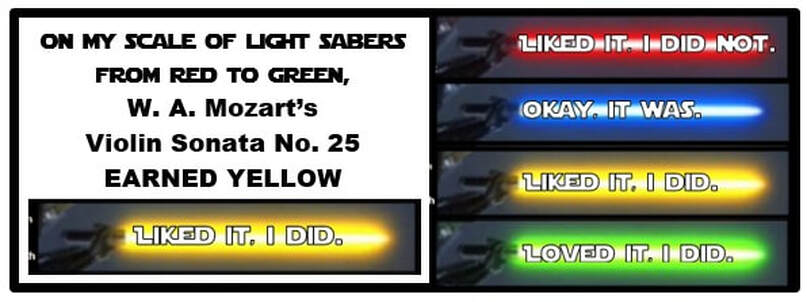
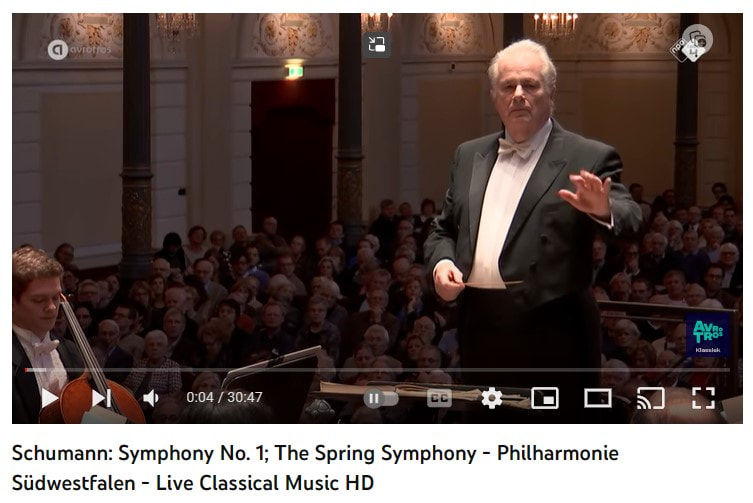
Robert Schumann made it onto my Top 100 list of Classical Music Favorites with one of his piano works, and that, in a way, mirrors my knowledge of Schumann’s music – all piano and no orchestral works. Now, I don’t mean to imply that Schumann did not compose orchestral works – he did; I just know little to nothing about them – so I selected his very first piece for full orchestra to listen to this week, his Symphony No. 1 in B Flat. Schumann composed the symphony in 1841 (he was 31 at the time), and prior to this he was known for his works for the piano and voice. It was his wife Clara who encouraged him to write symphonic music, noting in her diary, "it would be best if he composed for orchestra; his imagination cannot find sufficient scope on the piano... His compositions are all orchestral in feeling... My highest wish is that he should compose for orchestra—that is his field! May I succeed in bringing him to it!" The symphony consists of four movements, and the premiere took place under the baton of Felix Mendelssohn in March of 1841 in Leipzig, where – according to an article on Wikipedia (HERE) – “the symphony was warmly received” – and that two word description aptly summarizes how I responded to hearing the symphony now for a few times: it was “warmly received.” It is, indeed, a pleasant enough piece – lively at times and amiable – but it just wasn’t momentous or memorable. The first movement, Andante un poco maestoso – Allegro molto vivace, opens with a trumpet fanfare that called to mind the opening to Tchaikovsky’s Symphony No. 4 – but that symphony was written between 1877 and 1878 so, obviously, Schumann was in no way alluding to it. However, that was the issue I had with Schumann’s work – I kept hearing other works and influences in it. A hint of Mendelssohn here, and a flash of Beethoven there – and even at about eight minutes into the first movement, there was a build up to a Wagnerian climax. The movement is pleasant enough, originally titled by Schuman as “The Beginning of Spring" (as he titled each of the four movements), and it was described by the composer as a "summons to awakening.” But it and the other three movements seem to be more copycat than original – and that statement might be unfair to Schumann because some of the works I “heard” in his symphony could have been written at a later date (as was the Tchaikovsky Fourth as noted above); however, for this work, it seemed to me that Schumann threw various composers’ styles and motifs into a Cuisine Art processor and blended it all into a mix of other the composers’ traits, tones and turns of a phrase leaving one to wonder what, exactly, is the Schumann sound? 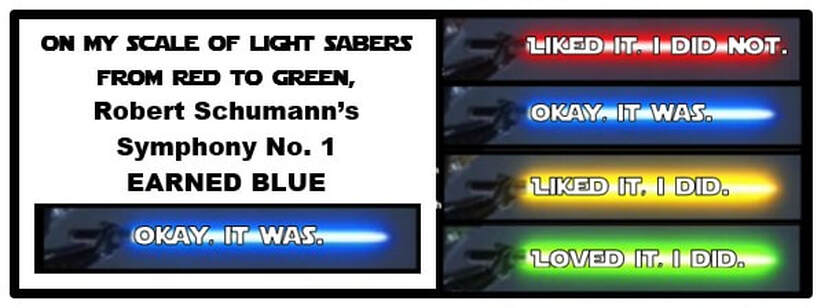
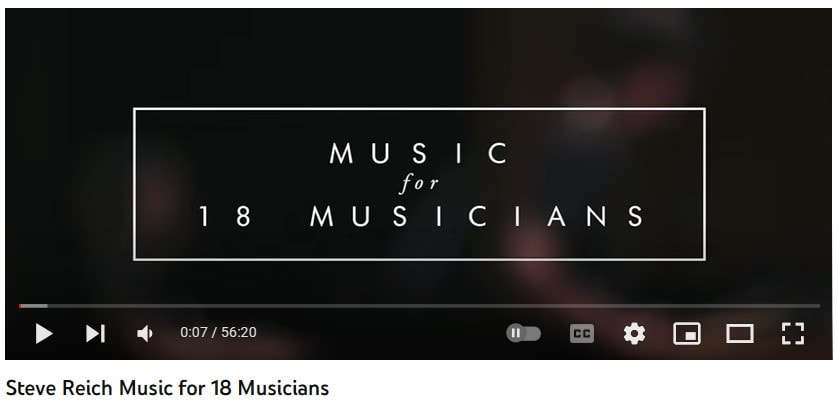
I've had some success this year listening to new (i.e, new to me) piano concertos -- and by "success" I mean I discovered concertos which I rated yellow or even green on my scale of light sabers. Plus, along the way through the years on this site, I've listened to piano concertos with two, three and even four pianos. Just last week I listened to and rated J. S. Bach's Concerto for Four Pianos (HERE). That made me wonder if any concerto had ever been written for five pianos. I ran a Google search, but I did not find such a work. So what'd I do? I ran a search for a piano concerto with six pianos -- and lo and behold, I found a work by Steve Reich (though not a concerto) called "Six Pianos." That was going to be my featured piece for this week; however, when I began to listen to the piece I thought it sounded very familiar. Turns out that "Six Pianos" is Reich's work "Six Marimbas" transcribed for pianos. Well, let me correct that. "Six Marimbas" is actually a variation of the piano work composed several years later. Here's info from an article on Wikipedia: "Six Pianos is a minimalist piece for six pianos by the American composer Steve Reich. It was completed in March 1973. He also composed a variation for six marimbas, called Six Marimbas, in 1986. The world première performance of Six Pianos was in May 1973 at the John Weber Gallery in New York City." The complete article is HERE. On to Plan B: I searched for a concerto for multiple instruments, and it didn't take long to find Reich's "Music for 18 Musician." Though not a concerto, I decided to listen to Reich's work. Here's some info on the work from another article on Wikipedia: "Music for 18 Musicians is a work of minimalist music composed by Steve Reich during 1974–1976. Its world premiere was on April 24, 1976, at The Town Hall in New York City. In his introduction to the score, Reich mentions that although the piece is named Music for 18 Musicians, it is not necessarily advisable to perform the piece with that few players due to the extensive need for musicians to perform on multiple instruments. The piece is based on a cycle of eleven chords. A small piece of music is based on each chord, and the piece returns to the original cycle at the end. The sections are named 'Pulses.' and Section I-XI. This was Reich's first attempt at writing for larger ensembles, and the extension of performers resulted in a growth of psychoacoustic effects, which fascinated Reich, and he noted that he would like to 'explore this idea further.'" The complete article is HERE. I realize that minimalist music isn't for everyone, and I admit -- minimalism is not my usual "go to" when I listen to classical music (which is rather frequently); however, I found Reich's work to be captivating if not hypnotic, mesmerizing. I only have one suggestion for a change -- based on personal preference -- in case, Mr. Reich, if you happen to stumble upon my comments (LOL) -- and I'll get to my proposition soon. First, let me relate an anecdote from a concert I attended a couple of years ago where the featured orchestra played Maurice Ravel's "Bolero." I love Ravel's "Bolero," and I've heard it many times. As a matter of fact, "Bolero" is on my Top 100 list of classical music "favorites," HERE. So why the info on "Bolero"? Well, when the snare drum player -- situated front and center at this particular concert -- began drumming Bolero's hypnotic rhythm, I think I began to sweat! LOL -- I'd never thought much of the pressure on a singular musician during a live performance, but at this concert I was witnessing it firsthand! The cadence is described (again, on Wikipedia, HERE) as follows: "It is built over an unchanging ostinato rhythm played 169 times (I added the underline) on one or more snare drums that remains constant throughout the piece" -- although there is, in fact, a slight deviation between the two repeating measures of the "constant" rhythm (on the third beat of each measure), shown below: 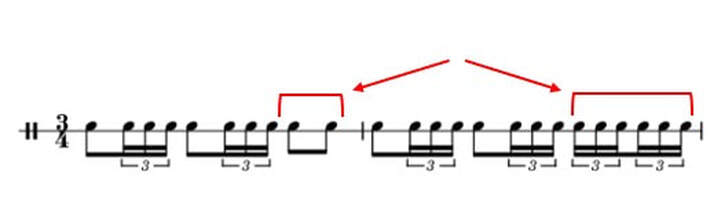 Therefore, 169 times the drummer plays two eighth notes on the third beat, and 169 times the drummer plays two sets of sixteenth note triplets -- and how they can keep it straight as the song repeats over and over and over and over (etc.) is beyond me! So that brings me back to Reich's "Music for 18 Musicians." Listening to the work on the video linked above is one thing, but watching the video is quite another! I watched in complete awe and admiration as the musicians (LOL -- I never counted them -- I assume there were eighteen) stayed in sync with one another. I know how easy it could have been for any one of them to have gotten lost in the mesmeric melodies and rhythms. Not only is the music trance-inducing, but their performance was engrossing. Of course, the music itself is engrossing and intriguing (and begging pardon for being redundant -- hypnotic and mesmerizing). It reminds me of taking a train trip and looking out the window only to be lulled into a trance-like reverie induced by the constant but ever- (and gradually) changing scenery. The blur of landscape is hypnotic, mesmerizing (oops, I said it again). I thoroughly enjoyed the piece. I found it to be -- well, I suspect you already know what two adjectives I would use to describe the music; however, I would suggest one change for the work -- and interestingly, it's related to an issue I had with another piece by Reich I listened to months ago ("Different Trains," reviewed the week of 6/7/2021, HERE): I just wasn't keen on the human voices as some of the "instruments," and I would have preferred those parts to have been written for specific woodwind or other instruments. The voices grew on me over the course of the hour-long performance, so I got "over it." LOL. Still, I think I would have preferred additional woodwinds. And still -- I loved the piece. ; ) 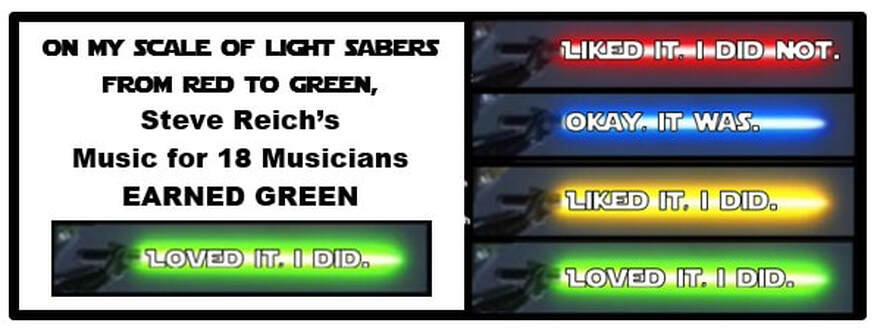
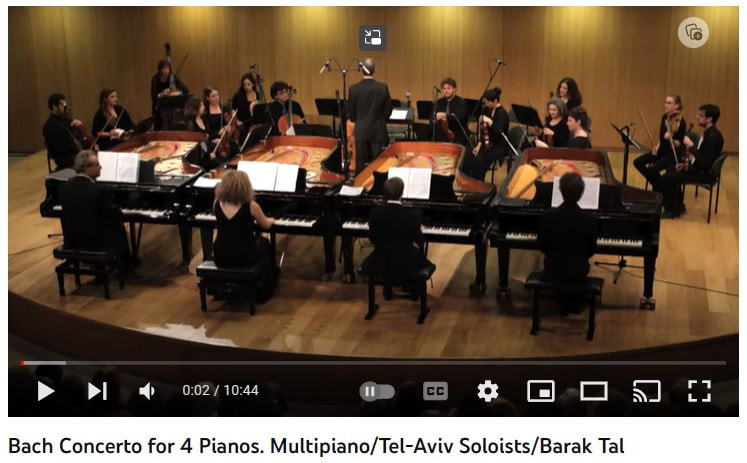
I won’t say that I’m NOT a fan of Baroque music, but I will say that it’s not my “go to” when I listen to classical music. LOL – my wife always calls it “George Washington music,” and she pictures people dancing minuets or gavottes in their colonial garb and colonial slipper shoes. When a Baroque tune plays on the radio, she demonstrates the dancing with two of her fingers and asks me to “turn off that George Washington music.” She’s not a fan of the Baroque period at all. Well, just prior to this week I saw a photograph on Instagram of four grand pianos jammed together on a stage along with a small chamber orchestra. The caption said something about the Bach Concerto for Four Pianos. Say what? Four pianos? Sounded interesting to me, so I chose it as my piece to listen to this week – though I’ll admit, I listened when my wife wasn’t home. LOL. In a nutshell: I loved it! It was about as Bach as Bach could be with his counterpoint, his harmonizations, his rhythms, form and textures, and his motivic development. Hmm, I will say, though, that I’m not so sure that Bach even wrote the piece. It seems from some (limited) research that Bach transcribed music by Vivaldi? Plus, the original transcription was for four harpsichords, not four pianos, so I listened to the piece with both instrumentations, four pianos and four harpsichords. I enjoyed both (as a matter of fact, I think the second movement worked better with the harpsichords). Here’s info on the concerto from an article on Wikipedia (HERE): “Bach made a number of transcriptions of Antonio Vivaldi's concertos, especially from his Op. 3 set, entitled L'estro armonico. Bach adapted them for solo harpsichord and solo organ, but for the Concerto for 4 violins in B minor, Op. 3 No. 10, RV 580, he decided upon the unique solution of using four harpsichords and orchestra. This is thus the only orchestral harpsichord concerto by Bach which was not an adaptation of his own material.” By the way, an article on Vivaldi’s L'estro armonico (which, of course, discusses Bach's transcription) is HERE. The concerto consists of three movements:
The first and third movements are certainly methodical, energetic, and bright. Think of Bach’s two- and three-part inventions on steroids. I currently have two friends in England at a reunion at Oxford, and I have to say that in looking at their Instagram pics, I can’t help but think of this concerto as the perfect soundtrack for their adventure. Think “Paper Chase” (for those old enough to know what I’m talking about). Anyway, I thoroughly enjoyed this concerto – both on the pianos and with the harpsichords. Hmm…maybe this will inspire me to listen to more Bach, Vivaldi, and/or Baroque. I’ll just make sure my wife’s not around when I do. LOL. 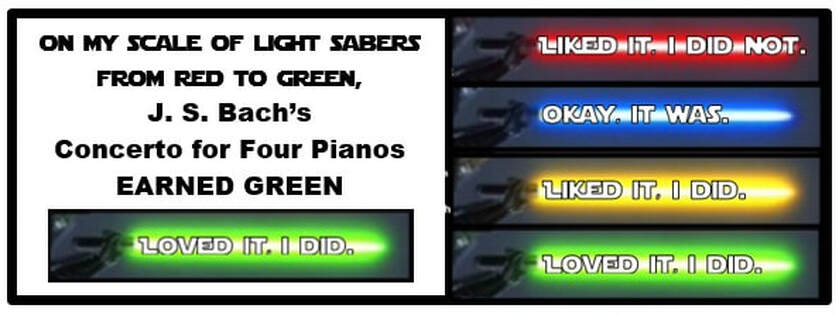
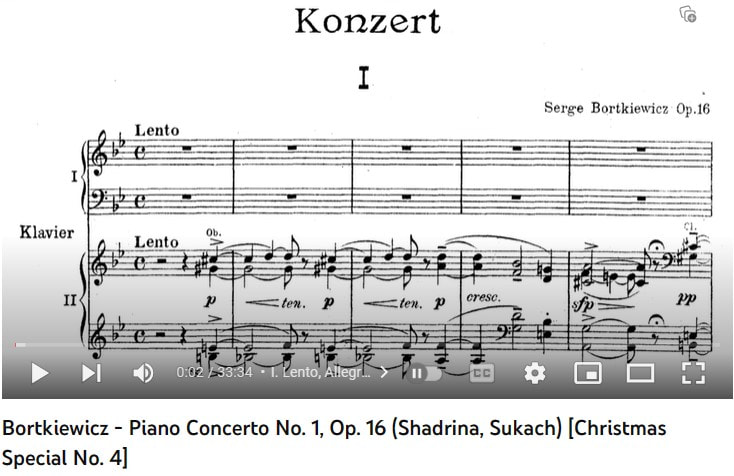
Dearest Reader: I apologize for the delay in reviewing this piece. My life suddenly got busy, busy, busy when I accepted a long-term substitute teaching position at a local middle school to help out a friend (the principal of the school). My last day of teaching will be in early June, and then I have a short trip to Chicago and Detroit. Once I get back, I'll finish up my comments and rating for this piece (on of before June 17th), and then I'll get back on track as of June 18th with a new piece. At that point, I'll be back to retirement life! Stay tuned! ; ) Ugh! I've procrastinated long enough, and it's time for me to get back into the swing of things! As you know from the note above, my "life of leisure" as a retiree got interrupted when I agreed to go back into teaching as a long-term substitute to help out a principal-friend of mine at a local middle school. I had a blast, but now I'm back to care-free days -- and I even made the trip to Chicago and Detroit (as mentioned above) -- and... Well, I've just been putzing around -- so enough putzing! (Is that how you spell "putzing"?) I need to finish this review and then move on! LOL. I listened to Bortkiewsicz' concerto way back in April when I first made this post, and I'm listening to it again now as I type. I chose the work because I'd had decent luck this year with piano concertos (i.e., I'd found some real gems), so I had high hopes; alas, the overall result (i.e., my reaction, review and rating) did not live up to the height of my hopes. Back in early April I reviewed a piano concerto by Victor Kosenko, and I wrote, "Think the Tchaikovsky concerto in B flat minor, the opening of the Grieg A minor concerto, the Warsaw Concerto, or the Brahms No. 1 in D minor. There is nothing more exciting than a pianist pounding out a piano line in an explosion of power and passion with a rousing orchestration behind it – and THAT is the Kosenko concerto in a nutshell." Well, the same can be said for the Bortkiewicz concerto. There's excitement, there's pounding, there's power and passion, there's even a trill in the upper registers of the piano that plays on for twenty measures. However, there doesn't seem to be any real cohesion to the concerto. Oh, there are parts that are Rachmaninoff-like, Tchaikovsky-ish, Grieg-y, and even Gershwin-esque. But as a whole, the work is not greater than the sum of its parts. It's pleasant to listen to and certainly exciting at times -- but it's really a hodgepodge of themes presented in a patchwork of pounding and prowess. Meh. 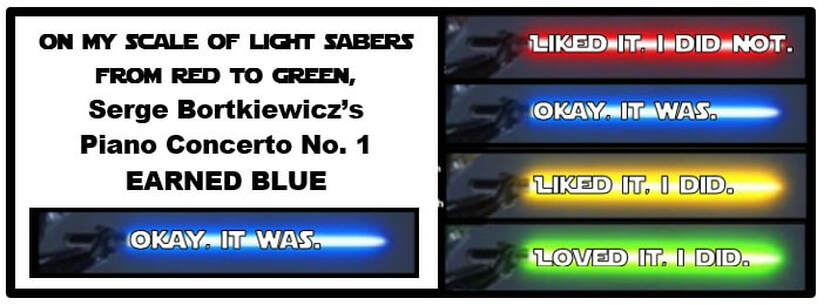
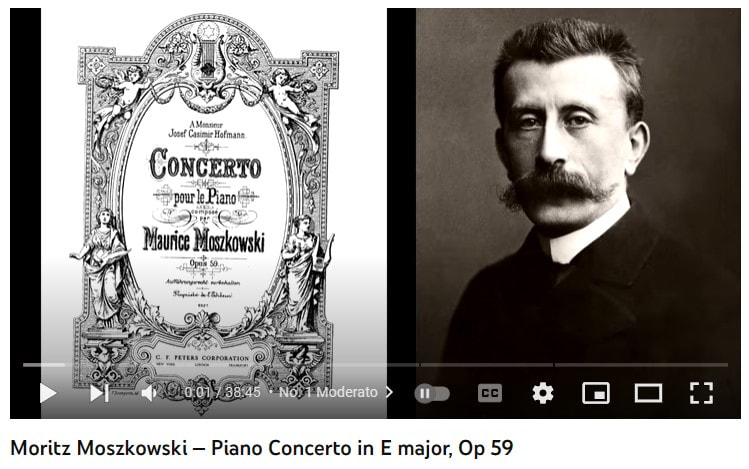
LOL -- this is a first! I selected a piece to listen to this week -- a piece I've never heard before: Moritz Moszkowski's Piano Concerto in E Major.
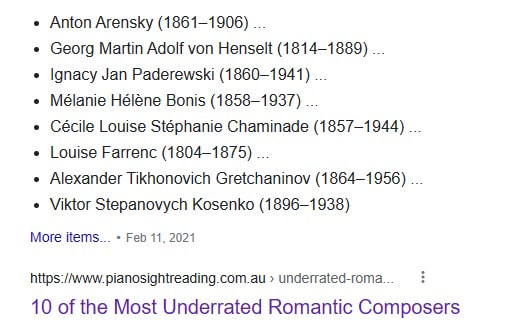
Last week I listened to and rated Victor Kosenko's piano concerto -- a work by the 8th name on the list -- and I loved it. I figured that I'd had such good luck with his piano concerto, let's try to keep the streak going (if one enthusiastic review for a piano concerto can be considered a "streak"), so I thought I'd give Moszkowski's piano concerto a try. Well, this morning -- just as I started to type this post -- I played Moszkowski's concerto in the background for a "first" listen. Immediately, I thought, "gee, this sounds familiar. Have I heard this piece before?" Then it dawned on me -- I think I've reviewed this concerto before for this very blog! I searched my archive list shown at the right, and there was the name, "Moszkowski." I clicked on it, and voila -- I reviewed this work during the week of 3/14/21, HERE. It turns out I was working through a list at ClassicFM.com entitled "The 11 most underrated composers in classical music," HERE. As far as I know, this is the first time I've selected a piece to listen to "for the first time" for a second time! LOL! Back to the drawing board! I'll pick another piece to listen to later today! Okay, so I've selected a new piece for this week: I went to Spotify, typed in the name "Moszkowski," and picked the first work in a list of pieces by the composer, "Overture in D Major." You can listen to the overture HERE. I have many favorite overtures. Some of them are overtures to operas (Tannhauser, Rienzi, Candide, The Barber of Seville, etc.), and others are just orchestral works (An Outdoor Overture, Overture di Ballo, Hebrides Overture, etc.). Therefore, I tried to find information on this piece to find out if it were an overture to an opera, an introductory piece for some incidental music for a play, or a standalone orchestral work. There was little information available, but from what I could determine, this is, indeed, a standalone work, one with no opus number. And, as a matter of fact, this was Moszkowski's first composition. A site about an album of works by Moszkowski (HERE) states, "This third volume presents his very first orchestral work, a strikingly assured Overture in D major, written when he was seventeen...." Another site I explored (HERE) asserts that the Overture is "unpublished" (at least at the time the article was written?) and that it was discovered "around 2011." This site also states that "The main thematic material in this Overture closely resembles that of some motives in the 1st movement of his Symphony, which he would...write about a year later." I've not heard Moszkowski's Symphony, so I can't speak to that, but I will say that some of this overture did remind me very much of another work -- but I can only sing it; I can't recall its name! LOL! NOTE: SEE THE "UPDATE" BELOW. I FIGURED OUT WHAT THE PIECE IS! ; ) One of these days, when I hear that piece again, I'll come back to this page and update it with info as to what that song is! Anyway, I did enjoy Moszkowski's Overture (D Major is such a cheerful key!), but I don't see it being one of my "go-to" overtures like all of the titles I mentioned above. Of course, if Moszkowski was 17 when he wrote this piece, then that's really quite impressive! It's definitely worth a listen. 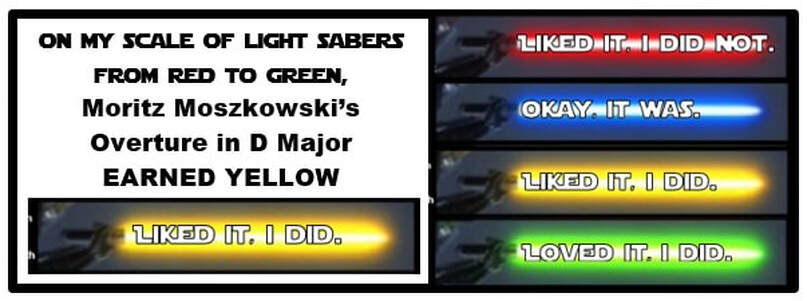 UPDATE: I figured out the name of the piece that Moszkowski's overtures reminded me of, the Ruy Blas Overture by Felix Mendelssohn (composed in 1839) -- specifically the melody at about 2:45 into the YouTube video (with score) posted HERE. |
A New Hope:As the header above says, each week I will listen to a piece of classical music that I've never heard before, and then I will report out what I thought about it. Archives
September 2023
Categories
All
|
 RSS Feed
